Navigating the AI Crisis in Education
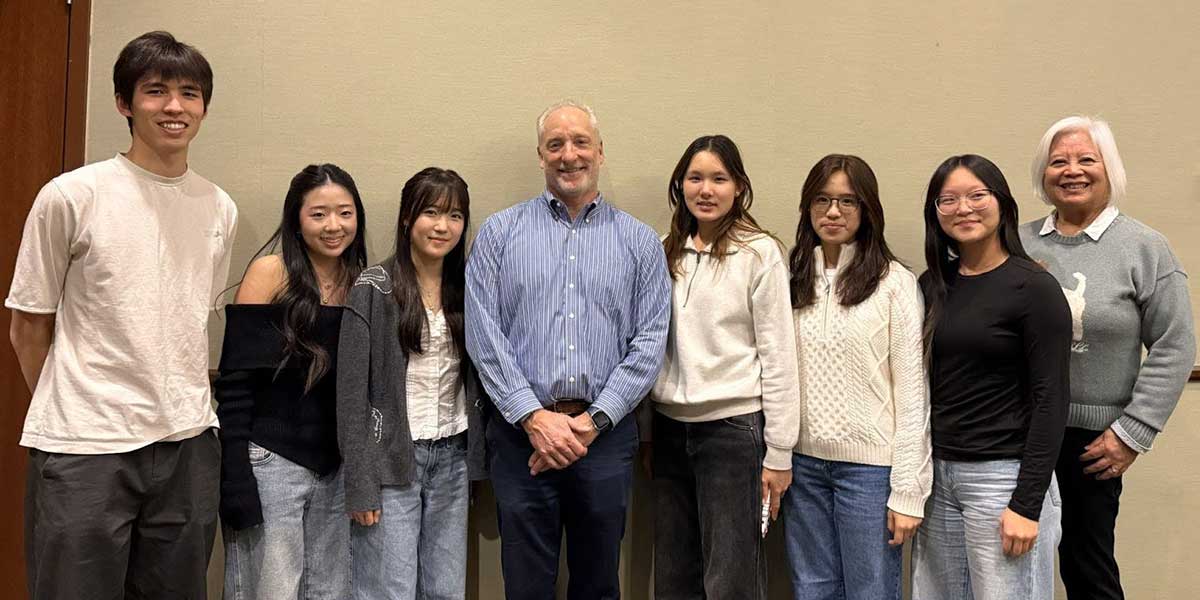
Photo above from left: James Farmer ’27, Kasey Lee ’27, Leslie Han ’27, Dr. Mike Smith ’79, Jane Wei ’27, Megan Cheng ’27, Allison Li ’27 and Director, Computer Science Signature Experience Joy Wolfe
Harvard professor and Peddie alumnus Dr. Mike Smith discusses the challenges and opportunities of artificial intelligence in the classroom.
By Kasey Lee ’27
On January 8, Peddie’s Computer Science Signature Experience welcomed Dr. Mike Smith ’79, a current Peddie trustee and the professor who taught CS50, one of the most popular computer science courses in the world, with more than 140 million views on YouTube. Dr. Smith is the John H. Finley, Jr. Professor of Engineering and Applied Sciences at Harvard University and a Distinguished Service Professor. He has taught at Harvard since the early 1990s and served for 11 years as Dean of the Faculty of Arts and Sciences, where he helped guide major decisions about teaching and research across the university. Much of his work focuses on educational technology and on how computing is reshaping learning, institutions and the way students engage with ideas.
Dr. Smith spoke about how artificial intelligence is transforming education, particularly through what he described as the “AI crisis” in the classroom. Drawing on his own research and experience teaching AI to non-computer science students, he discussed a failed attempt to build an AI teaching fellow designed to tutor students. In its first version, the system was under-constrained and gave away full solutions rather than guiding students with hints. In later versions, he increased constraints, which made the system so limited that it became unhelpful. These failures led to a key lesson: While chatbots can teach information, building an effective tutor that supports learning without replacing thinking is far more difficult than it seems.
Dr. Smith also emphasized that prompting alone is a weak mechanism for controlling what AI reveals. Beyond technical challenges, he explored how student motivation changes when assignments feel easily solvable by AI, and he argued for rethinking, rather than simply banning or permitting AI use. He shared examples of experiential assignments focused on ethics, consent, and real-world impact, such as projects on voice cloning and data science, that encourage deeper engagement and creativity.
Rather than framing AI as a threat, Dr. Smith encouraged educators to restore balance by combining instructor checkpoints, group work, office hours, traditional resources and responsible chatbot use. He stressed that AI should not replace teachers, but can enable more ambitious and experimental learning when used carefully. Many students appreciated his focus on authentic agency and the idea that AI can help them learn more deeply about topics they genuinely care about. Ultimately, Dr. Smith reframed the “AI crisis” as a shift in perspective, suggesting that while the tools are new, education itself has not fundamentally changed, and that thoughtful design can turn uncertainty into opportunity.